Choosing the Right Survey Item Types in the Listening Event Builder
Designing an effective employee experience survey is not just about the topics you ask about but how you ask about them. The precise item types you select directly shape the insights you’ll generate, how results can be reported, and what decisions the data can support. Strong listening events intentionally combine multiple item types, each serving a distinct analytical purpose, and Perceptyx offers a robust variety of item types to support this.
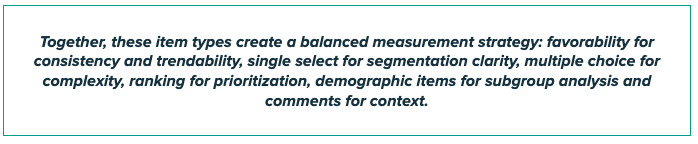
Favorability Scales: Favorability based items including agreement, frequency, satisfaction, and quality are the backbone of employee experience measurement. They provide the consistency required for benchmarking and trending over time, and they support structured reporting across teams, functions, and demographic groups. Our best practice is a 5-point Likert agreement scale. It captures meaningful variation without overcomplicating the response task and produces stable favorability metrics for reporting. When comparability and longitudinal insight are priorities, favorability items should anchor your survey design.
eNPS Scales: Closely related but analytically distinct are NPS-style scales, including eNPS. These use an 11-point scale (0–10) and categorize respondents as promoters, passives, or detractors. This longer scale forces variability, but can add complexity for interpretation. NPS items are particularly effective when you want a clear, executive-friendly metric that summarizes advocacy or loyalty in a single score. Because they produce a net score, they are well suited for high-level reporting and benchmarking across organizations. However, eNPS is typically a single item and doesn’t provide deep insight to inform action. For that reason, NPS items work best when paired with additional scaled or open-ended questions that provide context behind the score.
Single Select Items: Complementing favorability items are single select items, which require respondents to choose one option from a mutually exclusive set. These are particularly useful when you need clean segmentation variables or when employees must commit to a definitive choice. This can help clarify specific actions or focus areas. Single select items also create clean groups that can be used for comparison to strengthen downstream filtering and reporting.
Demographic Items: When using single select formats, it’s helpful to think about how the item will be used. While both survey items and demographic items allow respondents to choose one option, they serve slightly different purposes. Demographic items are most commonly used to capture profile characteristics that allow results to be segmented and compared across distinct groups. If the main goal is to filter or compare responses (for example, by role, tenure, or location), the item should be set up as a demographic so it can be used consistently in reporting. Demographic questions should be used thoughtfully to balance the analytic value with maintaining trust of the participants.
Multiple Choice Items: For more complex employee experiences, multi-select (select all that apply) items introduce additional flexibility. Many workplace outcomes are influenced by multiple factors, and this format allows respondents to identify several factors simultaneously. These items are especially valuable when exploring breadth for example, identifying all contributors to workload stress or all factors that contributed to a decision to leave the organization in an exit survey. They offer detailed insights, but they need to be interpreted carefully because the percentages don’t always add up to 100%.
Ranking Items: When understanding relative importance is the objective, ranking items provide deeper prioritization insight. By requiring respondents to order options, ranking forces trade-offs and reveals what truly matters most. This format is particularly effective when informing resource allocation or strategic focus decisions. Instead of simply knowing what employees value, you learn what they value more.
Comment Items: Finally, open-ended items provide the qualitative layer of insight. This is where the “why” emerges. Open-ended responses capture nuance, context, and emerging ideas that structured items may not anticipate. Comments often explain patterns observed in scaled items and surface themes that would otherwise remain invisible. They can provide critical value for interpretation and depth to inform specific actions based on quantitative focus areas.
Best Practices for Scale Direction
The way response options are presented can have a subtle influence on how people answer. In some cases, respondents may be slightly more likely to select options that appear first, which is known as a primacy effect. Presenting options from negative to positive helps mitigate acquiescence bias, or the tendency for some respondents to default to agreement because it feels easier or more socially acceptable. A negative-to-positive progression makes “Agree” less likely to become an automatic selection, reducing any risk of artificially inflated favorable results. That said, these effects are generally subtle and insignificant in well designed surveys. They tend to become more noticeable only when respondents are unmotivated, speeding through long or repetitive surveys, or experiencing higher cognitive load.
Ascending scales also feel more natural for most people. In Western reading cultures, people are used to thinking left to right as moving from “less” to “more.” A low-to-high scale follows that pattern and pairs neatly with numeric coding (for example, 1 = Disagree and 5 = Agree). That alignment makes the survey feel intuitive for respondents and makes scoring and reporting more straightforward. This best practice is used widely across organizations as a survey design best practice, so adopting the low-to-high five point agreement scale ensures alignment with external benchmarks and supports meaningful comparison.
Even more important than direction, though, is consistency within the survey. Switching scale direction partway through a survey forces respondents to make a mental shift, which increases cognitive load and the risk of careless errors. While consistency matters most, using an ascending scale throughout tends to produce cleaner, more stable response patterns.

Best Practices for Survey Item Order
Randomization may be appropriate in experimental research, but it is not recommended in employee experience surveys. Responses are context-sensitive, and a logical, consistent flow supports interpretation, improves the respondent experience, and reduces cognitive load. Randomizing items or pages can disrupt that flow, weaken reliability, and increase behaviors such as speeding or straight-lining.
To strengthen measurement quality, group items by construct and by scale type (e.g., keep agreement items together), move from broad to specific topics, and maintain a consistent order across respondents and surveys. Perceptyx recommends placing outcome measures such as the Engagement Index at the beginning of the survey to avoid any potential priming effects that could be introduced by other items. Place more sensitive or evaluative items toward the end of the survey, after respondents have had time to engage and build trust in the process. Open-ended comment questions are also best positioned at the end, allowing participants to elaborate after reflecting on structured items.

Was this article helpful?
That’s Great!
Thank you for your feedback
Sorry! We couldn't be helpful
Thank you for your feedback
Feedback sent
We appreciate your effort and will try to fix the article