Listen
Not every question fits every participant. Conditional logic lets your event react to the person taking it, so people skip what does not apply to them and see follow-ups only when they are relevant.
This article covers Point-In-Time and Lifecycle events. You set up all three kinds of logic in the Content phase of the Event Builder, right alongside your questions.
Still adding questions or pages? Start with Add and Manage Questions | Point-In-Time & Lifecycle and Add and Manage Question Pages | Point-In-Time & Lifecycle. Logic is easier to set up once your content is in place.
This article walks through
Pick the Right Kind of Logic
There are three kinds of logic. They all answer the same question, which is who should see this, but they work at different levels.
| Logic | What it does | Where you set it | What can trigger it |
|---|---|---|---|
| Skip logic | Sends a participant forward, past questions that do not apply to them, or straight to the end of the event. | On a question or a self-select demographic question | The participant's answer to that question |
| Display logic | Shows a single question only when a condition is met. Everyone else never sees it. | On a question or a self-select demographic question | Answers to earlier questions, answers to demographic questions, or demographics from your participant data |
| Page logic | Shows a whole page of questions only when a condition is met. | On a page | The same triggers as display logic, and you can combine them with OR |
A quick way to decide: if you are hiding one question, use display logic. If you are hiding a group of questions that all apply to the same people, put them on their own page and use page logic. If you want someone to jump ahead based on how they just answered, use skip logic.
Before You Start
Get to the Content phase
- If you are already in the Event Builder, click Content in the left panel.
- If you are starting from Listen, find your event, click Manage Event, then click Content in the left panel.
Most of your logic work happens on the Questions tab. Logic on self-select demographic questions happens on the Demographics tab.
A few things to have in place
- For demographic questions, turn on the Demographics page first. The Demographics tab is available once the page is on for your event. Enable and Customize Event Pages | Point-In-Time & Lifecycle shows you how.
- To use demographics from your participant data as a condition, add your participants first. These are details like department or location that come from your human resources information system, not from questions in the event. The logic dialogs call them HRIS Demographics, and they are available once you have added participants with demographics in the Invite phase. Each logic dialog has a banner with a link that takes you there.
- Logic only looks backward. A condition can only be based on something the participant has already answered or on data you already have about them, so plan your question order with that in mind.
Apply Skip Logic
Skip logic moves a participant forward in the event based on how they answer a question. Say you have a set of questions only for full-time employees. If a participant says they are not full time, skip logic can send them past those questions to the next ones that apply to everyone.
Skip logic only moves people forward. It cannot send anyone back to an earlier point in the event.
What a question needs for skip logic
- It is a Favorability or Single Selection question.
- It is the only question on its page, or the last question on its page.
- The page after it has at least one question.
Add skip logic to a question
- On the Questions tab, click Add Logic next to the question.
- In the Edit Question dialog, click the Skip Logic tab. Every answer option for the question is listed, each with its own Skip to dropdown.
- For each answer that should send people somewhere else, open its Skip to dropdown and choose where to send them. You can pick a later question or the end of the event. Leave the other answers alone, and those participants simply carry on to the next page.
- Click Save.
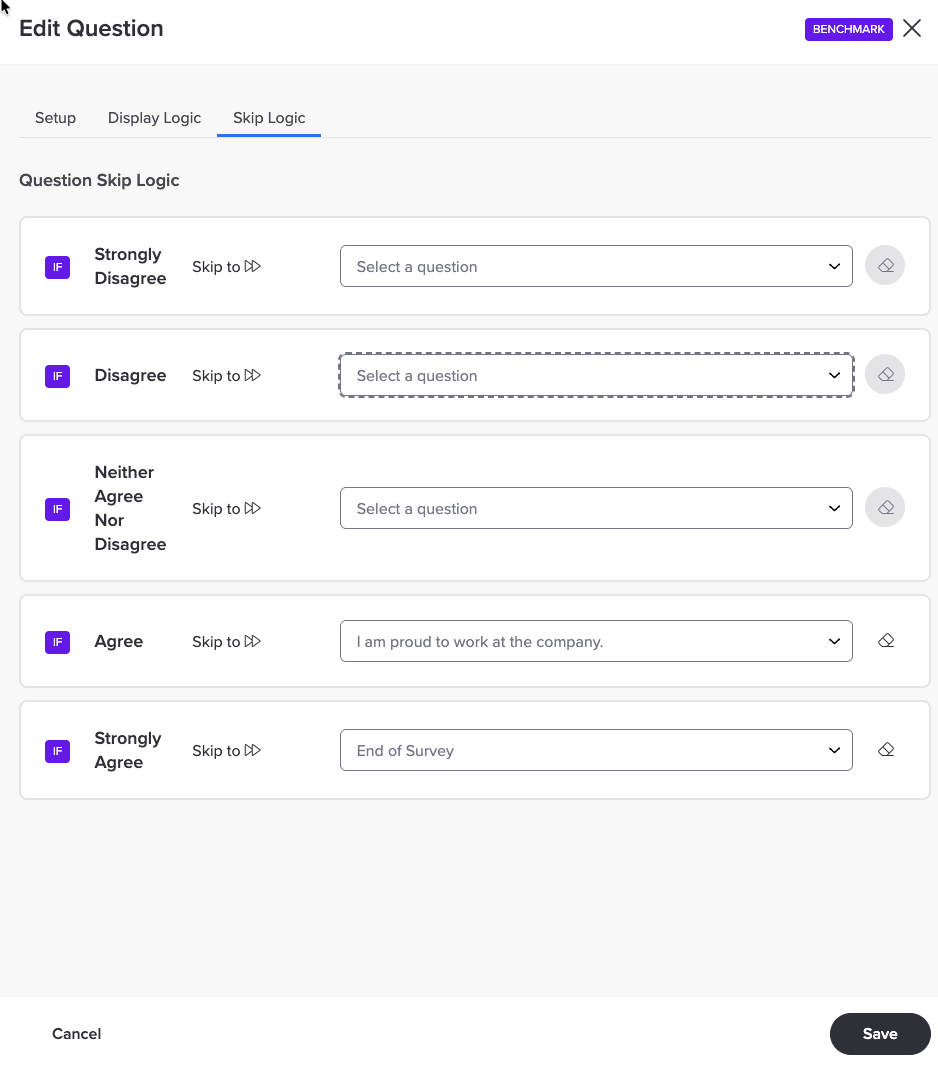
Once it is saved, an Edit Logic icon (two right arrows) appears next to the question. Click it any time to change or remove the logic.
Add skip logic to a demographic question
This works the same way, with the same requirements. The only difference is that you start on the Demographics tab and click Add Logic next to the self-select demographic question you want to use.
Note
On a demographic question, you can use skip logic or display logic, but not both. Pick the one that fits what you are trying to do.
Apply Display Logic
Display logic shows a question only to the people it is meant for. Here are two ways you might use it:
- If someone answers Disagree or Strongly Disagree to a question about staying with the company, show a follow-up asking what would encourage them to stay.
- If you want to ask part-time employees whether they are interested in full-time work, show that question only to people who picked Part-time on a demographic question.
With display logic you work backward. You start on the follow-up question and tell it which earlier answer, or which demographic, should make it appear. Because of that, display logic cannot go on the very first question in your event. There is nothing earlier for it to look at.
Add display logic to a question
- On the Questions tab, click Add Logic next to the question you want to show conditionally.
- In the Edit Question dialog, click the Display Logic tab.
- Open the Condition dropdown and choose what should trigger the question: an earlier question, a demographic question, or a demographic from your participant data.
- In the next dropdown, choose the specific question or demographic.
- In the last dropdown, choose the answers that should make the question appear. You can pick more than one.
- To add another condition, click the plus icon at the end of the row.
- Click Save.
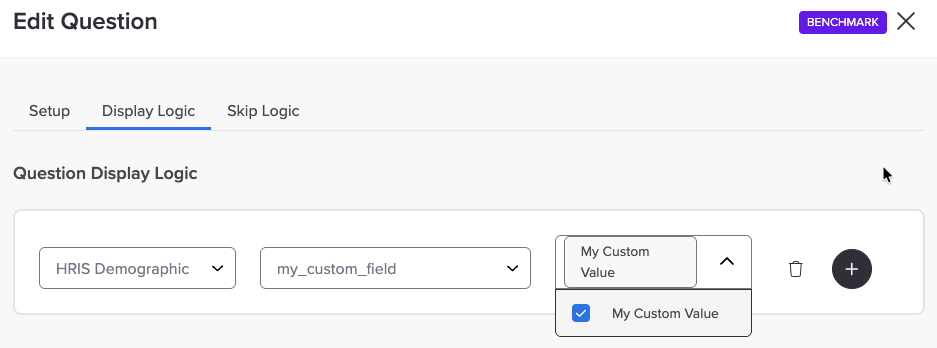
Once it is saved, a Display Rules icon appears next to the question. Hover over it to see which answers trigger it.
Tip
If the follow-up is an open-ended question, make its wording specific. If several follow-ups all say something like "Please elaborate," it is hard to tell them apart when you look at your comments later. For the example above, something like "What would need to change for you to consider staying?" works much better.
Add display logic to a demographic question
Start on the Demographics tab, click Add Logic next to the self-select demographic question, then follow the same steps. Remember that a demographic question can have display logic or skip logic, but not both.
Apply Page Logic
Page logic shows an entire page only when a condition is met. It works like display logic, just for a whole page at once. Say you want to ask only people in Finance and Research and Development about clarity of direction. Put those questions on their own page, then add page logic so the page shows only to people who pick one of those divisions.
Add page logic
- On the Questions tab, find the page and click Add Page Logic in the top right corner of the page.
- The Page Logic dialog opens. Under Show If, open the Condition dropdown and choose what should trigger the page: a question, a demographic question, or a demographic from your participant data.
- In the next dropdown, choose the specific question or demographic.
- In the last dropdown, choose the answers that should make the page appear. You can pick more than one.
- If a different condition should also show the page, click OR Condition and set up another row.
- Click Save and Apply.
Here is how that example reads. The page shows to anyone in Finance or Research and Development. It also shows to anyone outside those divisions who answered unfavorably to "I can see a clear link between my work and departmental objectives." The OR condition is what lets that second group in.
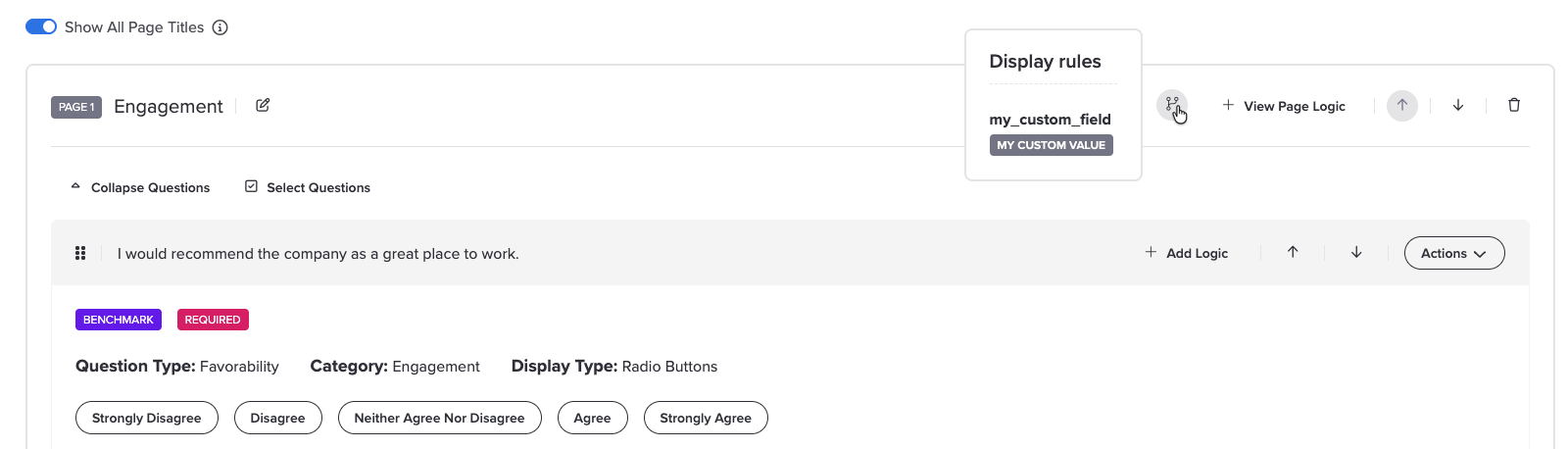
Once it is saved, a Display Rules icon appears at the top of the page. Hover over it to see the full set of rules.
Check Your Logic Before You Launch
Logic is easy to get slightly wrong, and participants will not tell you that a question never showed up. Before you launch, preview your event and click through it a few different ways. Answer the trigger questions differently each time and make sure people land where you expect.
If any of your logic uses demographics, preview the event as different groups of participants too. Preview Your Event | Point-In-Time & Lifecycle covers both kinds of preview.
What's next
Your logic is set up. Now see it the way participants will. Preview Your Event | Point-In-Time & Lifecycle walks you through previewing your event, including how it looks to different groups of participants.
Was this article helpful?
That’s Great!
Thank you for your feedback
Sorry! We couldn't be helpful
Thank you for your feedback
Feedback sent
We appreciate your effort and will try to fix the article