Act
Survey results are only useful if something changes afterward. Activate is the subscription that helps make that happen, with suggested action plans, regular nudges, and coaching whenever someone wants it.
Act is the place you go to make your results stick, and Activate makes the Act section smarter. It doesn't add a new tab or move anything around. Everything in this article shows up on the Act page you already use.
Activate works for everyone, not just managers. Managers get help picking what to work on and following through. Employees get short, practical suggestions in the tools they already use. Admins get tools to shape all of it and see whether it's landing.
Not sure what you have
Activate is set up a little differently for every organization. Things like where nudges come from, who receives them, and whether coaching is turned on can vary, and nudges and coaching can be turned on separately. If you're not sure what's included for your company, your Perceptyx contact can tell you.
This article walks through
Act and Activate, side by side
The two names look almost the same, so here's the short version. Act is a page in the Perceptyx platform, right next to Listen and Analyze. Every customer has it, and it's where action plans live. Activate is a subscription that adds help on top of that page.
Here's what Activate adds:
- Suggested action plans. After a survey, managers get a short list of the items most likely to make a difference for their team, instead of starting from a full report.
- Intelligent Nudges. Short, practical suggestions delivered in the flow of work, tied to action plans and to the things people said they want to get better at.
- On-demand coaching. A chat window for working through a tricky conversation or an action plan that's stuck, available any time it's turned on for someone.
- Admin tools. Ways to shape the nudges people get, and engagement data that shows whether the program is working.
Using 360 feedback?
Action planning works a little differently for 360 feedback events. See Use 360 Feedback with Activate for the details.
Suggested action plans
The hardest part of action planning is usually picking where to start. Activate looks across a manager's listening results and suggests the items most likely to have an impact right now.
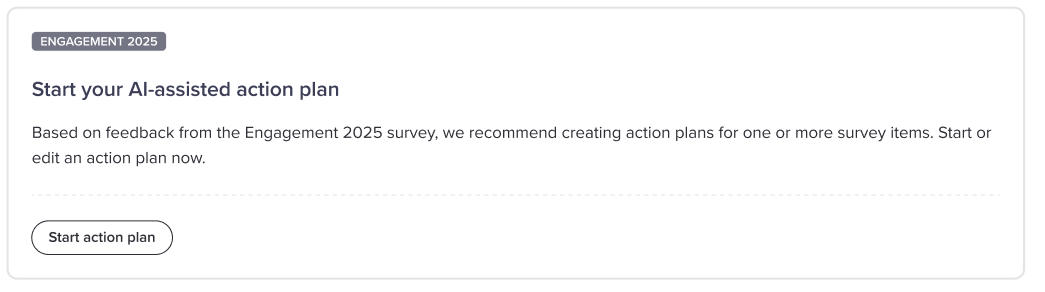
Once results are available after a listening event, managers see a prompt on the Act page to start their plan. Depending on how your company is set up, the same prompt can also arrive by email, Microsoft Teams, or Slack.
Clicking Start Action Plan shows the recommended survey items, based on the most recent listening data for that manager and their team.
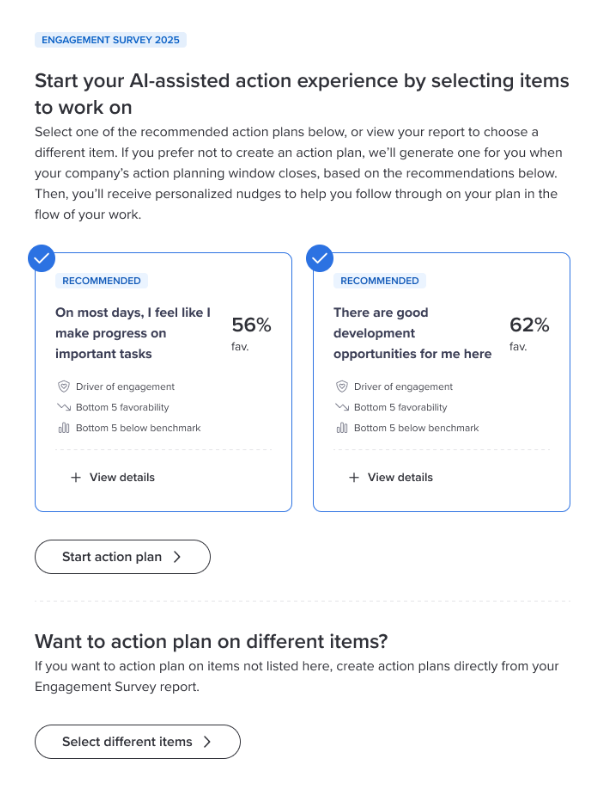
From there, the manager picks one or more items and builds the plan:
- Add up to two commitments.
- Write any notes they want to keep with the plan.
- Choose up to three follow-up dates.
Not feeling the suggestions? Click Select Different Items to open Advanced Reporting and pick something else.
Every plan built this way generates nudges to help with follow-through. For Point-In-Time events, those go to the manager and their team. For 360 feedback events, they go to the manager.
Good to know
If a manager doesn't start a plan on their own, Activate can create one for them from the top recommended items, so the nudges still go out.
For the full walkthrough, see Create an Action Plan.
Intelligent Nudges
Writing an action plan is the easy part. Remembering it three weeks later is harder. Intelligent Nudges are short, personalized suggestions, grounded in behavioral science, that help people build the habits behind their plans and goals.
Nudges arrive on a regular schedule in the Action Feed on the Act page and in the tools people already work in, like email, Microsoft Teams, or Slack. Each one can come from:
- An action plan the person owns, or one their manager created for the team.
- A personal focus area the person chose for themselves.
- A behavior your organization wants to build.
- A campaign an admin set up for a specific group.
The first line of each nudge tells you which of these it's connected to. Only action plans from a person's most recent Point-In-Time event and most recent 360 feedback event generate nudges, so older plans don't keep sending them.
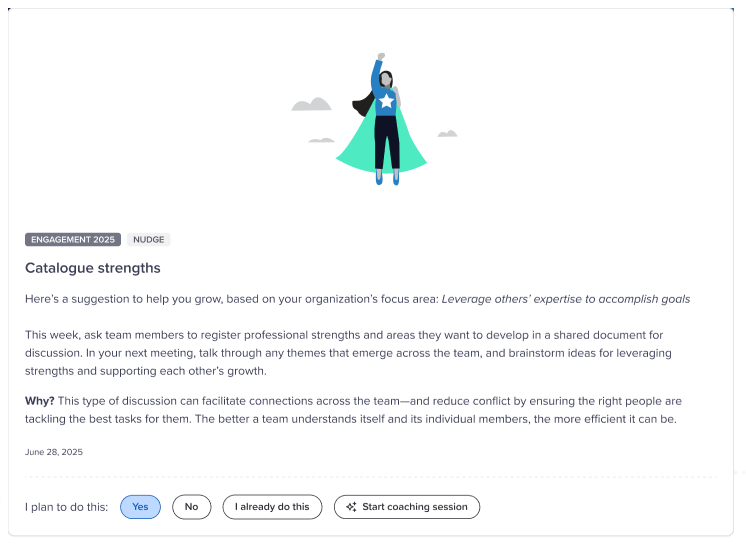
Reacting to a nudge
Every nudge has an I plan to do this row with Yes, No, and I already do this. Clicking one tells Activate what's useful, and it uses that to tune future nudges. If coaching is turned on, there's also a Start coaching session button for talking through how to put the nudge into practice.
Coaching preferences
Anyone can personalize the nudges they get. Clicking Update Preferences opens a short, optional set of questions about how your work is structured, plus a chance to pick up to three personal focus areas.
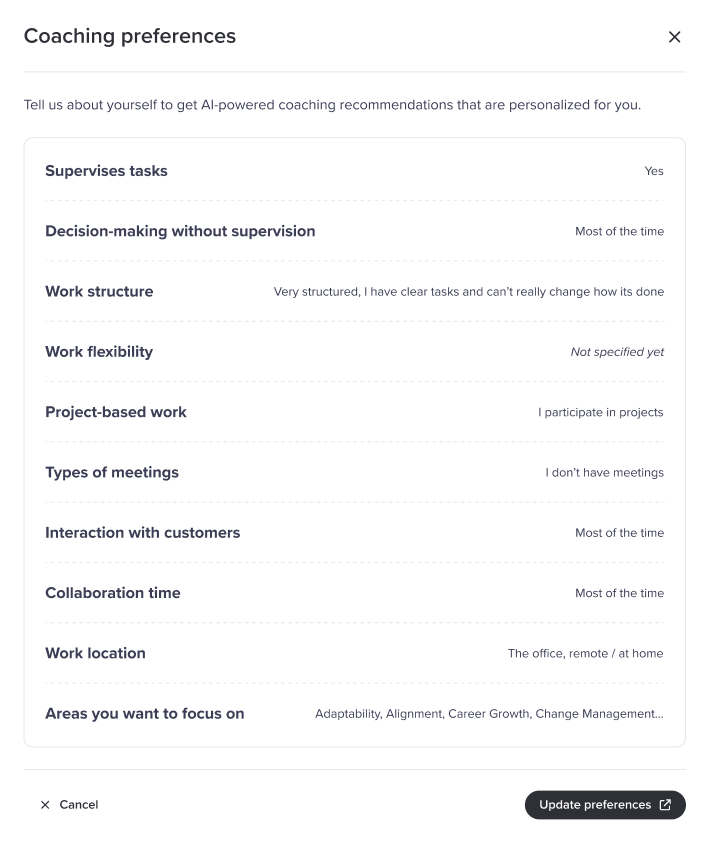
See Set Coaching Preferences for the steps.
Finding your nudges later
Your Action Feed keeps every nudge, newest first, alongside action plan prompts and reminders.
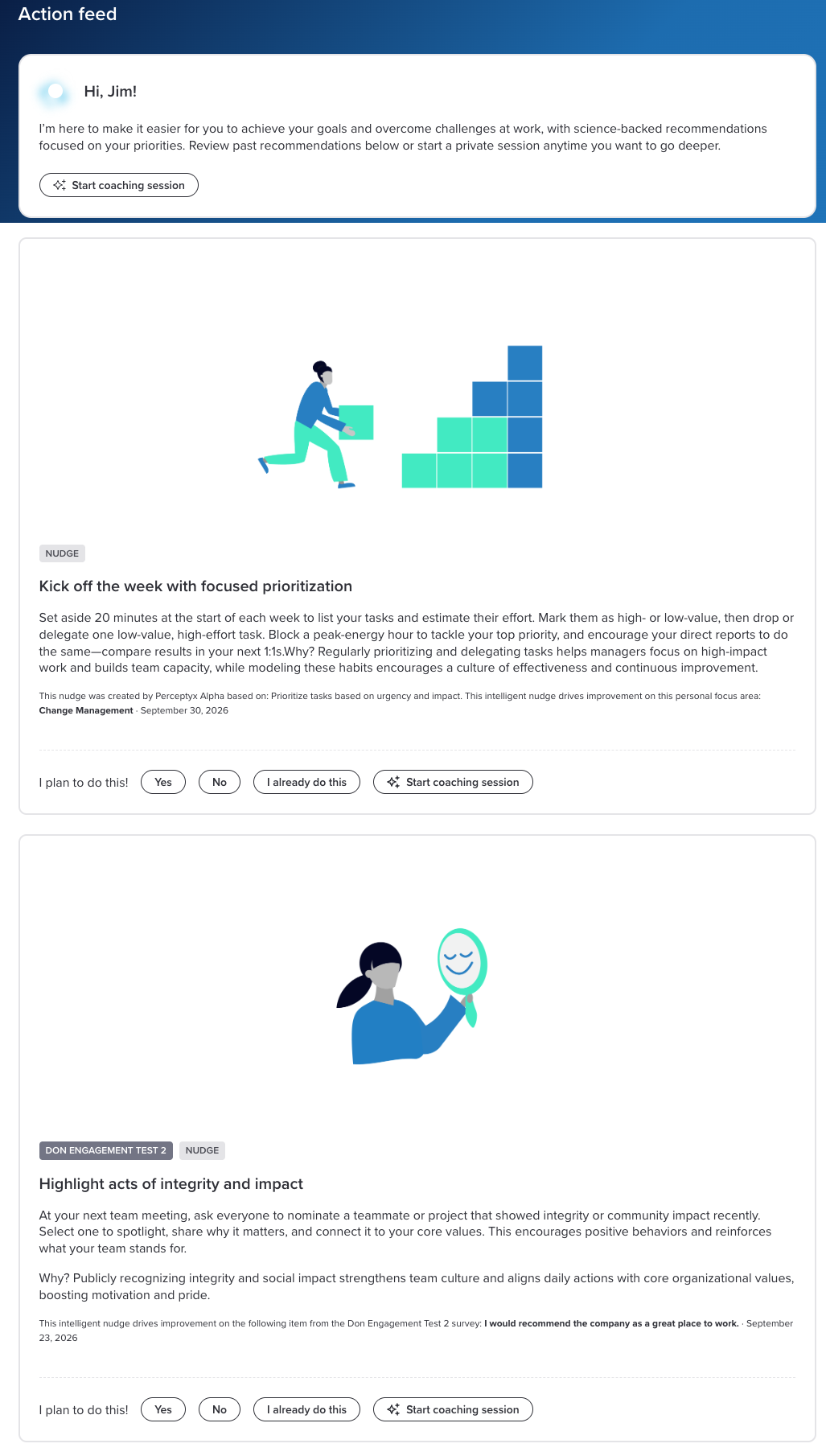
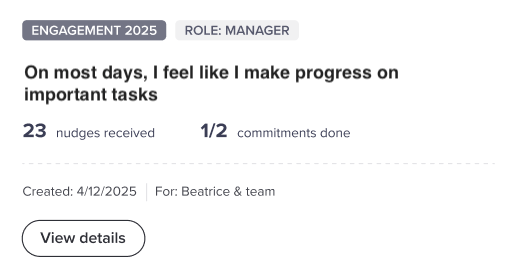
Each card under Active Action Plans also shows how many nudges you've received for that plan.
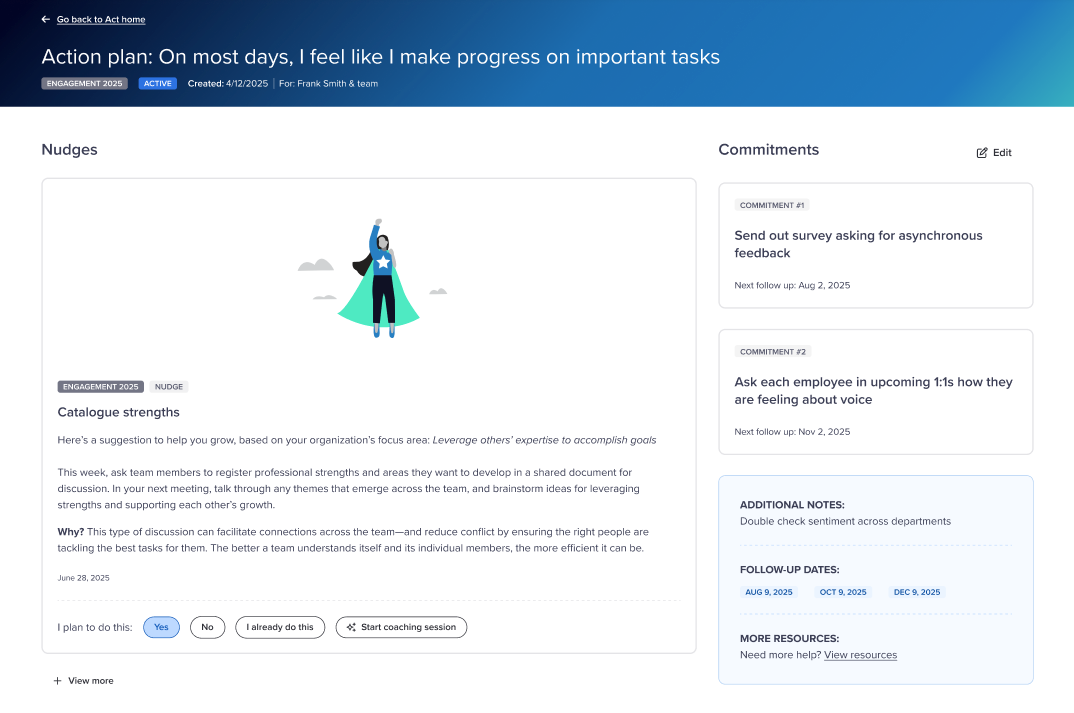
Click View Details on a card to see that plan's nudges, newest first, next to its commitments and follow-up dates.
For more on working with nudges, see Interact with Intelligent Nudges.
On-demand coaching
When coaching is turned on for someone, they can start a coaching session any time. It's a chat window for things like making sense of feedback, getting ready for a hard conversation, or figuring out what to put in an action plan. The guidance is grounded in behavioral science and in the person's own results, so it's specific to their situation.
Type a question into the message box, or click one of the suggested prompts to get started. You can rate any response with a thumbs up or thumbs down, which helps tailor future sessions.
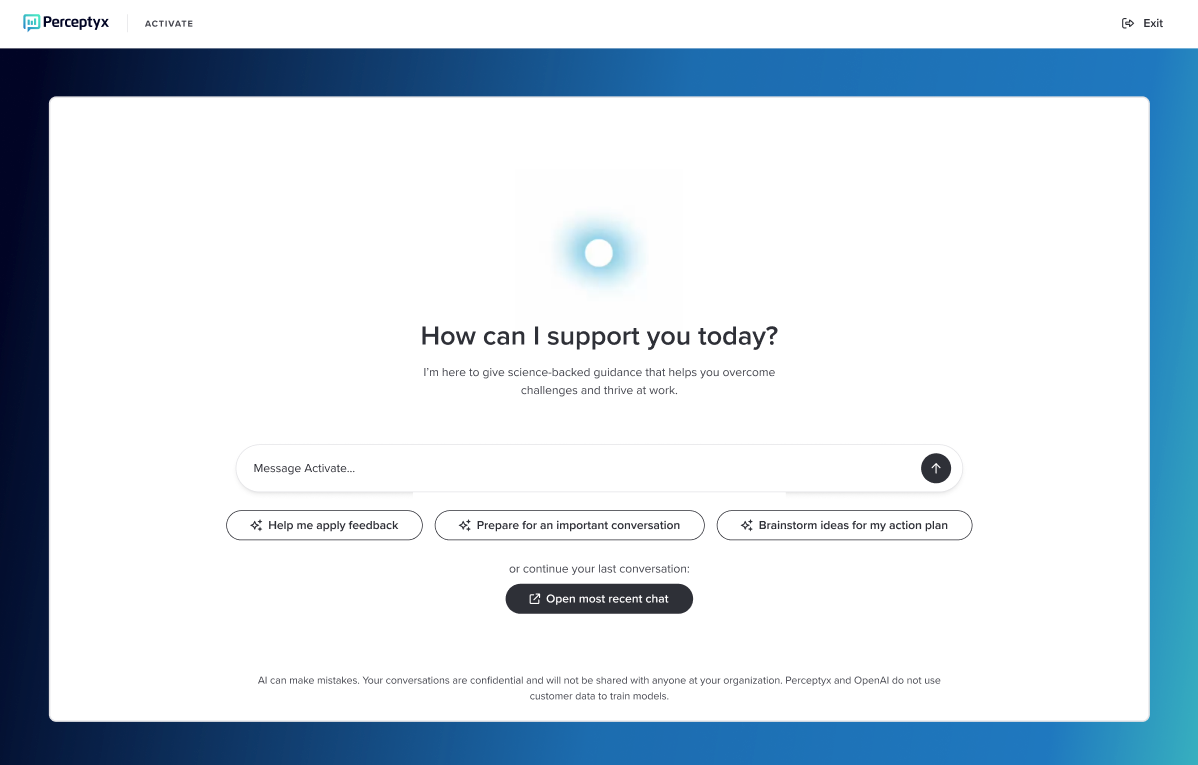
Coaching works in about 60 languages with no setup. Just write in the language you're most comfortable with. Activate can also invite people into a session at useful moments, like when it's time to build an action plan, and sessions can start straight from a nudge.
Turned on per person
Coaching is turned on for specific people in your organization. If you'd like access, check with your admin.
For the full walkthrough, see Use On-Demand Coaching.
Tools for admins
Most of the time Activate picks nudges on its own. These tools let admins point it at your own material and your own priorities. You'll find them under Advanced Tools on the Act page.
- Custom Learning Links. Attach links to your own resources, like learning courses, career tools, or a benefits portal, so they show up right inside nudges. See Add and Manage Custom Learning Links for Nudges (Admins Only).
- Nudge Generator. Upload existing learning and development material and turn it into nudges you can review and edit, so training sticks after the session ends. See Creating Nudges with Nudge Generator (Admins Only).
- Campaigns. Send a focused set of nudges to a group you choose, for a period you set. Handy for known moments like a reorganization, performance review season, or a new expectation you're rolling out to managers. Campaign nudges rotate into the usual schedule, so nobody gets more nudges than normal. See Create and Manage Campaigns (Admins Only).
Tracking engagement in Act Metrics
Act Metrics shows whether action planning and nudges are actually being used. Open it from Advanced Tools on the Act page.
Who sees what
Admins, HR business partners, and leaders can see action planning data for the people they support. Nudge and coaching engagement data is for admins only.
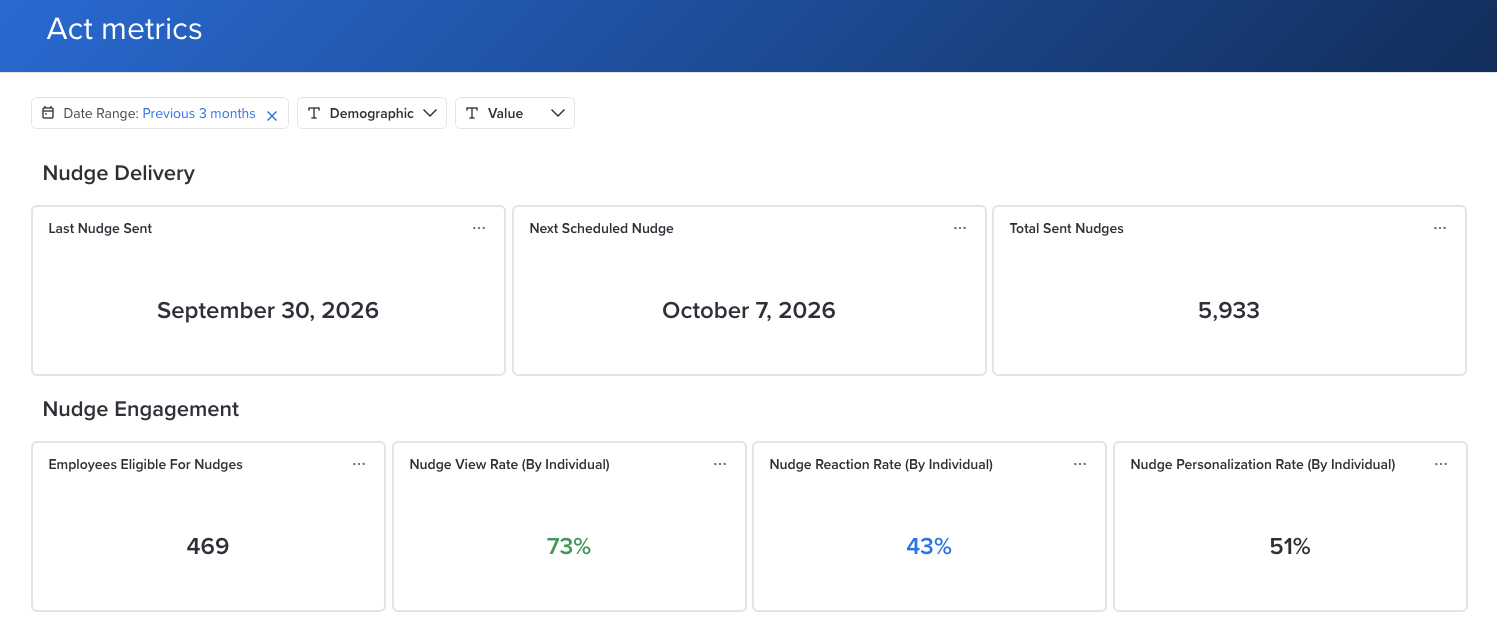
Nudge engagement
Filter everything by date range and by any demographic, then check:
- Nudge Delivery Status. When the last nudge went out, when the next one is scheduled, and how many were sent.
- Nudge Engagement Summary. How many people are eligible for nudges, and what share of them viewed or reacted to one.
- Nudge view rate over time. A trend line you can split by demographic group, with a goal line at 45 percent.
- Top nudge behaviors. Which behaviors people are being nudged on most, filterable by whether the nudge came from an action plan, a personal focus area, or a campaign.
- Learning Link Engagement and Nudge personalization. Learning link clicks, if you use them, and how many people have set their coaching preferences.
You'll also see an activity persona breakdown labeled as legacy metrics. Those are being retired, so build your reporting around view rate and reaction rate instead.
Coaching engagement
If coaching is turned on, the bottom of the dashboard shows how many employees chatted with Activate and how many conversations they started. This section always covers the last 90 days and doesn't follow the date range filter.

Privacy
Groups with fewer than five people never show data, so individual employees can't be picked out.
For a full tour of the dashboard, see Act Metrics Dashboard.
What's next
Ready to put it to work? Create an Action Plan walks through building your first plan, and Act tours the rest of the page Activate lives on.
Was this article helpful?
That’s Great!
Thank you for your feedback
Sorry! We couldn't be helpful
Thank you for your feedback
Feedback sent
We appreciate your effort and will try to fix the article